
The Ants Go Marching
Stephen King 8- The Long Walk by Stephen King

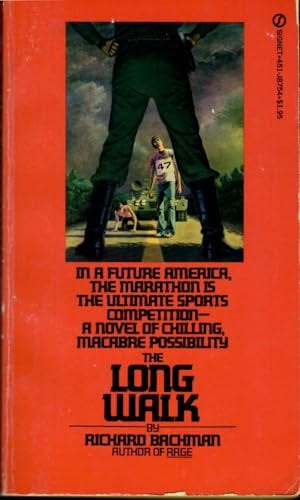
What’s Behind Door Number #1, Johnny
A reflection by M. J. Moran
The Long Walk by Stephen King
1979 as Richard Bachman
Reading copy
The Bachman Books by Stephen King
Signet 1986
“The Long Walk” is King’s first novel although it is his eighth book in publishing order. Coincidentally with this reading it has just been adapted to the silver screen. After reading the novel, I’m a little uneasy about watching the film. That is a testament to how disturbing the story is.
I’m an old school horror fan when it comes to movies with books I’m less informed. But in my mind there are different types of horror stories. One where the antagonists are put into a series of horrific situations, the audience wondering how they will survive until the end. Another is the gut punch story, dealing a horrific idea with the punch coming at the end.
<Spoiler alert- the next paragraph discusses Shirley Jackson’s “The Lottery”>
Shirley Jackson’s “The Lottery” is the inspiration for “The Long Walk” and an example of the gut punch ending. Jackson’s tale is set in every town U.S.A. where an annual harvest festival is held. Part of the festival is a lottery where first a household’s name is drawn and then a household’s member’s name is drawn. The story seems like a nice wholesome slice of American life until the gut punch ending which upset the readers of the New Yorker at the time and made the story a classic.
“The Long Walk” is the child of “The Lottery”. It feels like a slice of American life circa the 1970s with heavy shadows. King even describes one of the towns the walkers march through as being out of Shirley Jackson story, just to let us know its lineage.
The premise is that a group of 100 teenage boys begin a walk along a set route. They must maintain a speed of 4 milers per hour or more receiving warnings if they fall below that speed. Walkers who garner warnings can have them erased by keeping the pace for an hour after the warning. Those who lapse four times get their ticket bought. If the reader isn’t clear on what buying the ticket means, King lets us know as the first to fail is shot in the head. The survivor of the 100 gets whatever his heart desires at the end of the walk.
Starting out in Maine, our protagonist is Ray Garraty and the other boys he interacts with, particularly Pete McVie and Stebbins. As they walk, background stories are revealed as well as the process of being chosen for the Long Walk. The Walk itself is a national event with spectators lining the route and national television coverage, the boys being treated as celebrities even though only one will survive.
At first there seems to be an incongruity with the towns etc being presented as contemporary. King will eventually give a few facts to let the reader know this is an alternate America where World War II did not end in 1945. It’s a subtle indicator but it’s there. The change in history led to America becoming adopting an authoritarian regime where citizens can be squadded away, never to be heard from again.
I stated above that I group horror stories into grouping. An example of putting characters through a series of events would be King’s “The Mist”. Frank Darabont would add the gut punch ending when adapting the novella for film.
“The Long Walk” is a third option where the horror is the story. We know what is going to happen to all the boys except for one. The horror is watching them drop one by one, the reactions evoked by the deaths. The horror is knowing that each of the participants knowingly competed to most likely commit suicide. Mixed in is the crown reaction, a spectacle one akin to the Romans watching the gladiator contests.
The story fits the proverbial cliche of watching a train wreck, you know it isn’t ending well but you can’t take your eyes off of it. The story is almost excruciating in pacing, plodding along as the boys interact. But it is also the perfect pacing for the story being told. The reader feels the pain and emotion as the Walk continues.
Since it is a Richard Bachman story it is considered a lesser work by King but I find “The Long Walk” to be powerful. A comment on where we as a society could easily end up. I’m glad it was the first King story published but it demonstrates that even early on, King wrote sympathetic and real characters even in horrific settings. As for the movie, I’m not in a hurry to watch it since, I’m not sure I’m up for going through the same emotional wringer as experienced with the novel.
Coincidentally, we watched the movie last night. It has some differences from the book, particularly at the very end, but also much in common. Obviously, we follow the walkers and learn more about their lives, why they chose to undergo this terrible ordeal, etc. Some moments are even more visceral on screen than on the page. It, like the book, is horrific in that you stay with the walkers mile by mile, death by death. Powerful in either medium.